unconformity symposium - the watch
- j_a_laing

- Jun 1
- 5 min read
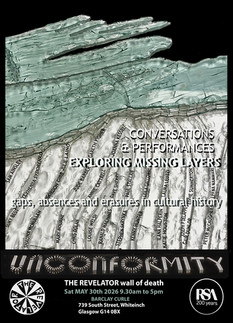
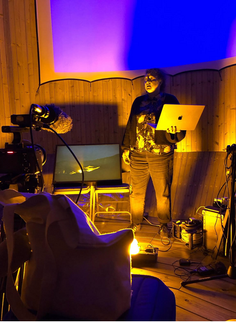
Another fascinating event at The Revelator art space in Glasgow. UNCONFORMITY symposium, jointly delivered by RSA 200 and Stephen Skyrynka, sought to explore missing layers in cultural history. I spoke about The Watch, a lost habit of wakefulness between two sleeps. I brought along my low pressure sodium streetlight to demonstrate the impact of artificial illumination on our circadian and creative rhythms.



The Watch performance text (7 minute read)
Between two astronomical twilights, there is nighttime. It’s a layer of experience we associate with darkness and is often characterised as a locus of danger, fear, crime, uncertainty. Night can warp and amplify physical and psychological states and heighten anxiety, pleasure, pain, creativity. It can bring relief from the demands of other people, quietness, time to think.
Between the end of one day and the beginning of another most of us find a few hours to drift off. In this third of our existence, deep sleepers are unconscious to varying degrees. Light sleepers, insomniacs and shift workers, though, are also affected by physiological transitions that make this period uncannily different from day. In some senses, in terms of the theme of this symposium, an embodied unconformity becomes apparent in our experience of time. The dead of night, when sleep is expected, is the portal to a missing tier. Consciousness slips around, and much that passes is ‘intempesta’, without time, half-remembered. We’re woolly with residual, lactic dregs from nightmares and dreams. Whatever we live through in those hours is often beyond articulation.
In 2012, I read a book called At Day’s Close by A. Roger Ekirch. It offered a portrait of pre-industrial nighttime and brought to attention our ancient, natural biphasic sleep pattern. Before gas and electric illumination became commonplace, lighting, by candles was expensive, inefficient and risky. So, people, according to this book and other literature, often felt dread as light faded. And this fear was not irrational. Violent crime was five times more frequent than it is today, and occurred most commonly in darkness. Sleep was a vulnerability. Spirits, ghouls, visitations all troubled people restless in infested beds with other humans and sometimes animals.
There was nothing certain about light. People ran out of candles and celestial sources such as moonlight and starlight could be obliterated by cloud at any moment. In this absence, we slept in two phases: first sleep and second sleep, punctuated by a period of activity sometimes called The Watch. During this one to two hour segment of wakefulness, people got up, lay thinking, wrote, tended to animals, worried, worked, had sex, and in cities, went to coffee shops. It was, for many a natural, productive and creative time.
The Watch, though, has been evolved out of our sleep pattern by contemporary artificial lighting practices. Our circadian rhythms are disrupted by streetlights, digital devices, car headlamps. And modern, consolidated sleep makes an unconformity of the hours between our eyes closing and waking in the morning. As in the geological gaps in rock formations, there is an awareness of matter that existed, but is gone. Who came into the room as we nodded off? What did we dream about? What residues lurk between night stratas?
I’m often awake till cock-crow and beyond, immersed in blue and white LED beams. I work across The Watch, filling the sleep gap with pixels and poetry. An all-nighter has a flow unattainable in daylight. Others in the household are asleep, and the cats are out working the night shift. Interruptions are few and four, five, six hours pass as if they were one. This way of working is sometimes framed as a kind of anti-social eccentricity, but that’s when The Watch asserts its ancient rhythm, beneath perception, calling the layer it inhabits to attention. Noise abates and ideas speak into cool thin air.
Those were the hours I was looking for in 2016 when I went on a field trip to the remote island of Eigg. Reading Ekirch’s book coincided with my developing interest in night photography. My intention was to explore two things: my fear of darkness and my embodied feelings of negativity towards low pressure sodium, or LPS, streetlight. I’d been documenting this for a year or so, with urgency, as it was being phased out. I intended to work through nights in a space devoid of company using a phenomenological method to observe, intuit and describe my lived experience. I’d brought my own lamp, and planned to use the trip to get to its essence.
On the island, I knew I was entirely safe from human malice, so I couldn’t rationalise why, each night as the sun set, my stomach sank with it. It reminded me of the moments during the 1999 total eclipse in Cornwall when I felt an atavistic thump at the entirely logical disappearance of the sun, when I briefly had a primitive certainty that it wasn’t coming back. It reminded me of the first time I read Edgar Allan Poe’s story The Pit and the Pendulum, where candle after candle peters out despite every effort to keep them lit. The feeling came from the knowledge that light can be suddenly extinguished. I was stupidly afraid.
I turned on the lamp. Its monochrome intensity, which you can see now, provided an uncanny comfort and I started to document. I worked till the small hours, achieving a fair degree of absorption, then switched off earlier than planned in case it drained my off-grid electric wattage allocation, thus leaving me without the possibility of light. It takes 30 minutes for eye chemicals to recalibrate our vision, so I felt my way up the ladder to bed, uncertain of where my edges were. This immersion in lightlessness didn’t desensitise me over the visit, it in fact got worse, and, however much I gained from the experience, everything I made there has a slick of fear across it.
And joy.
REVEAL EIGG PHOTO
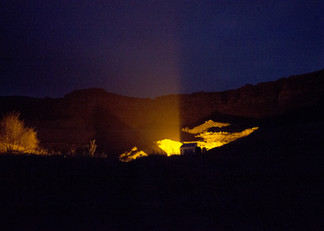
This image, taken on that trip, was transformative. After setting up the shot, I had to fight the urge to run back to The Bothy and lock the door. I wasn’t in danger, but I felt I was. I couldn’t see the camera controls or the detail on the monitor. I had no idea what images I had but I was working rhythmically, mining a stratum locked off in daytime shoots. Something kept me working past the end of first sleep, then second sleep. It was an invisible layer of creativity made manifest by the erosion of rationality. A surface of contact formed between muscle memory and intuition, and although fear stalked the gap between them, perhaps it was an ancestral memory of the habit of The Watch that induced a highly productive phase each night just before sunrise, even though I hadn’t been asleep.
I was exhausted the next day. The anxiety between sunset and waking, felt slightly shameful. I couldn’t explain what I’d been afraid of. But whatever occurred in those seven or so hours, asleep or awake, was being erased by daylight and a new understanding was laying down on top of the discomfort.
I opened up the laptop to see what I had on the SD card and saw that every second of that discomfort had been needed to transform my understanding of the light and dark I’d come to study. Some adjustments in photoshop revealed a fascinating energy that could only be fully conceived when surrounded by an overwhelming blackness. My streetlamp’s excess, my awe at the extent of its illumination of the hills behind and the sky above, articulated for me a fundamental facet of being.
Since that trip, whenever I photograph outdoors, immersed in low pressure sodium light, I reignite that co-existence of dread and joy.
It can’t be recorded.
It’s in the ancient space between the light being on
SWITCH OFF LIGHTBOX and LAMP
and being off.
image credits - UNCONFORMITY POSTER Stephen Skrynka | Eigg, excess Julie Laing | Performance photo Symposium guest (looking for source)


Comments